
BOOKS
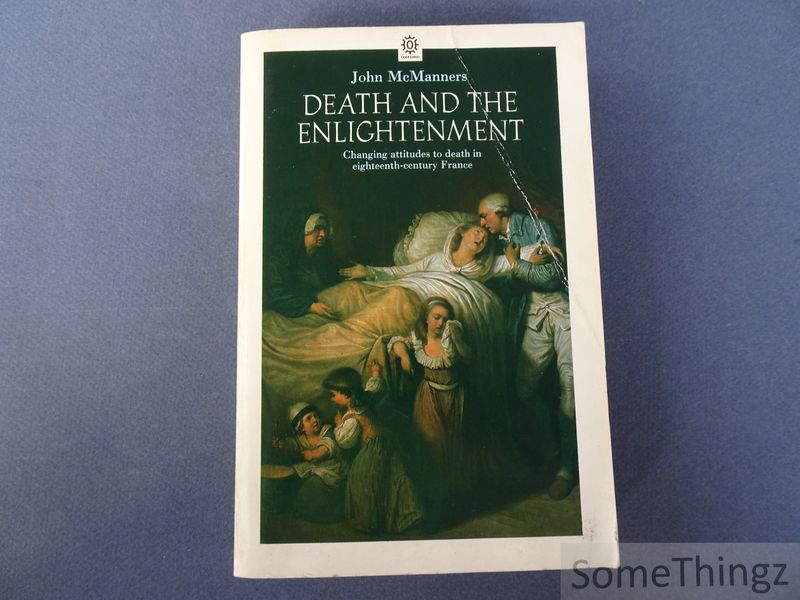
John McManners.
Death and the Enlightenment: Changing Attitudes to Death among Christians and Unbelievers in Eighteenth-Century France.
Oxford - New York, Oxford University Press, 1985.

€ 9.50
Paperback (pocket), vii+619pp., 13x19.5cm., in acceptable condition(spine folded, frontcover with crease, interior fine). ISBN: 0192818678. "Oxford Paperbacks".
Itemnummer 19798 
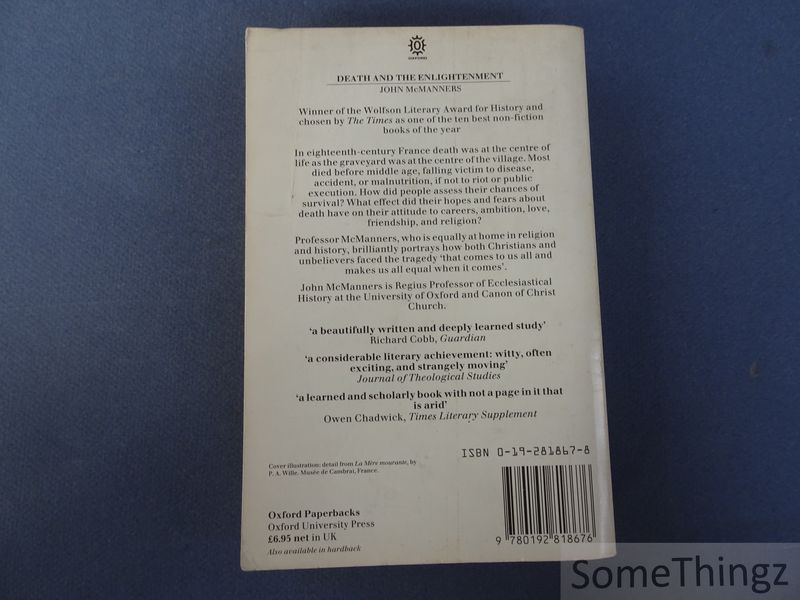
"Death and the Enlightenment" provides a thorough historical analysis of changing attitudes to death in eighteenth-century France. McManners examines how Christian beliefs and Enlightenment ideas influenced rituals, social customs, and perceptions of dying and the afterlife. The book addresses public executions, epidemics, death and birth cultures, and the tensions between traditional religious practices and emerging secular thinking. It is considered a classic survey of the social and cultural history of death in early modern France and remains a key reference for historians of religion, culture, and social practices. The book is organized into thematic chapters exploring various aspects of death and dying in eighteenth-century France. McManners begins with medical, religious, and cultural definitions of death, then examines how plagues, diseases, and death rituals shaped collective consciousness. Subsequent chapters cover public displays of power over life and death, such as executions, religious farewell rituals, and the influence of Enlightenment ideas on traditional dogmas. Social customs and archival records are combined with secondary interpretations to provide a comprehensive understanding of the interplay between fear, faith, and rationalization in attitudes toward death. John McManners (1927-2006) was a British historian specializing in the religious and social history of early modern Europe. He held academic positions in the United Kingdom and the United States. His research focused on the relationship between church institutions, social practices, and cultural change, with particular emphasis on eighteenth-century France. McManners was known for his rigorous source analysis and comprehensive historical syntheses, contributing significantly to both church history and cultural history.